.png)
How To: Design Your Exit Strategy By Building the Business Today That Someone Else Needs to Buy Tomorrow


Sorry, Julie Andrews, but the very beginning is actually a very bad place to start.
In the latest of our "How-To" guides, we're looking at how to design an exit strategy.
Whenever I sit down for a first meeting with a new Strategy or Investment Readiness client, I kick things off with a question that might initially seem out of scope for Founders looking to figure out what to do in the immediate future.
I ask: "Where, ultimately, do you want to take this business?". In the long term, for the end game, when it's time to say bye-bye.
It might sound too far in the future to worry about today, but, in a good strategy, the answer determines every single move we make from that moment on. Some founders tell me they want to build a legacy that outlives them; others admit they want to be sitting on a beach in five years with a very large cheque in the bank (same, babe, same, as long as I can be under a very large umbrella and plastered in sunscreen). Both these life goals are valid, but they require fundamentally different blueprints.
The uncomfortable truth is that, yeah, you need to live for today, but you can't exist without one eye on the future because a strategy that doesn’t account for the exit is just a plan to work forever. Without a North Star that points toward an eventual acquisition or IPO (but, honestly, probably an acquisition), you aren’t building a "business" so much as you're building a very high-pressure job for yourself. Without holidays.
To build a truly "exit-ready" business, your strategy must fulfil a dual mandate. It has to perform two high-wire acts simultaneously:
Deliver undeniable value to your current customers (The Proof): You must quantitatively prove that you are solving the problem you set out to solve. High retention, solid unit economics, and happy users are the "proof of life" that any acquirer will demand to see.
Shape the business into a "missing piece" (The Payoff): You need to identify a specific gap in a potential acquirer’s portfolio - a problem they can’t build or partner their way out of and thus must buy a solution to - and shape your company to fill it.
Designing your exit strategy from day one means that when the time comes to sell, you’re heading to market, just like you did with your product or service, with the exact solution to someone else’s biggest headache. You did it for customers and now you're doing it for an acquirer.
So how do we do this?
Phase 1 of designing your exit strategy: Identifying Your Ideal Acquirer Profile (IAP)
Most founders are intimately familiar with the steps taken to map a target market and identify their Ideal Customer Profile (ICP) - if you'd like a refresher, we have a whole book on that - "How To Find Your Customers".
When you've mapped your ICP, you know exactly whose problem you're are solving today. But if you want to sell the business tomorrow, you need to apply that same clinical level of segmentation to your Ideal Acquirer Profile (IAP).
Mapping your acquirer market is almost identical to mapping your target market. Just as you wouldn’t try to sell an enterprise SaaS product to a local bakery, you shouldn't assume every big tech firm is a potential buyer (no matter how proud you are of your business). Just as you would for your ICP, you need to understand your IAP's buying triggers, their internal pain points, and exactly how your business fits into their long-term roadmap.
Here's how:
Move beyond The Big Ones
It’s easy to point at Google, Salesforce, or Amazon and say, "They’ve got cash, they'll buy us."
Soz, but that isn't an IAP - that’s a daydream. A true IAP requires more nuance. You need to widen the search and be looking at the mid-market players, the legacy giants undergoing digital transformation, and the adjacent competitors who are losing market share to you. Remember, you're planning this today for something that's going to (hopefully) happen 5,10 years in the future - a period of time in which all of those players want to still be competing and you're building the thing that's going to help them do that.
Categorise your acquirers
To build a targeted list, you need to understand the intent behind the purchase. Acquirers generally fall into three buckets:
a. Strategic acquirers: These are often your competitors or companies in adjacent spaces. They'll be interested in buying your revenue, but they'll also be interested in buying your tech or your customers to defend their own territory or to enter a new market instantly.
b. Financial acquirers: Think Private Equity (PE) firms. They aren't looking for innovation as much as they're looking for a well-oiled machine that can deliver relatively friction-free returns. They want to see healthy EBITDA, predictable cash flow, and a business that can survive without the founder.
c. Platform acquirers: These are larger companies that want your product to become a core feature in their wider "suite" of tools. They'd be buying you to increase the stickiness of their own ecosystem because even the grownups fear bad retention metrics.
Define the gap
What's the hole in the IAP's boat that only your company can plug? Why will they buy you instead of building it themselves? Is it your unique IP that would take them five years to replicate? Is it your specific, hard-to-reach customer segment? Or is it your geographical footprint in a region where they're currently invisible?
Identifying this gap is the key to your exit strategy. Just like when you're building a product for your customers, when you know exactly why you're valuable to the IAPs, you can stop building features for everyone and start building the exact bridge they need to get across in the future.
Phase 2 of designing your exit strategy: Aligning your strategic roadmap to the IAP
Once you've identified your Ideal Acquirer Profile, your product roadmap is no longer just a list of cool things to build to delight your customers. Every sprint, every feature, and every architectural decision must be weighed against a single question: Does this also make us more valuable to our IAP?
You now get the joy of weighing every decision against three key angles - does this action get us closer to our financial goals whilst also delivering on the promises we've made to our customers and make us more attractive to a future acquirer.
Does that sound like a lot of things to balance just to decide what feature to build next? It should do, because it is a lot of things to balance just to decide what feature to build next.
Honestly, there's a reason most businesses fail. It's a lot of work to build a succesful business. It's even more work to build a successful business that's suitable for sale. I'm not here to tell you it's easy and riches are just around the corner. I'm here to be honest about the reality of growing a business and to teach you the key steps you need to get where you want to go.
Here's some key things to think about to help find this balance.
Enforce feature discipline
Founders are often tempted to follow the "shiny object" - something like a fun feature that might get some PR but isn't linked to the Mission, or a tangential tool that a single noisy customer is asking for. But if your IAP has gotten to the place where they're able to acquire you through discipline and focus; they'll know that these side quests are a liability.
Building features that don't align with your IAP’s core values is like adding a helipad to a house when you know the only potential buyer wants a perfectly-sized parking spot. You are spending capital to drift away from your exit.
Figure out the "build" versus "buy" maths
Large corporates are slow; they're weighed down by technical debt (yep, even the big kids have tech debt), internal politics, and analysis paralysis. This is your greatest advantage. Acquirers don't buy startups to get things that are easy to build; they buy them to get things they have tried and failed to build for years.
What are you distrupting with your startup? If you can solve a high-friction technical challenge or navigate a nightmare regulatory landscape that would take a massive corporate five years to replicate, you've made yourself indispensable. You are selling them speed and certainty - two things they can't manufacture themselves.
Kill your distractions
I wrote recently about the need to "Kill Your Darlings" and went into this in a lot more depth in that article. To summarise that here, in the context of an exit, this is extra brutal. As you move closer to the exit point, you need a properly strategic assessment of what needs to stay and what needs to go.
An acquirer wants a clean, modular engine they can plug into their existing machine. You might have a feature that is profitable today - a bespoke consulting arm or a legacy integration - but if that feature makes your business "unintegratable" or messy to a buyer, it has to go. The most successful exits aren't achieved by the companies that did the most, but by the companies that did the right things exceptionally well.
Phase 3 of designing your exit strategy: Quantifying the proof
Once you've figured out who your potential acquirers are and figured out what they want and how it aligns with what you were going to do for customers anyway, you next need to make sure that you're demonstrating this in a way that's really clear.
If you've raised a round, you'll be used to showing quant info on how your business is going to do or is doing what it says it wants to. Prepping exit data is no different. You might choose different metrics to show exit-readiness versus investment-readiness, but it's all sides of the same coin - you're objectively proving that you're amazing and people should give you money.
It's good to get into the discipline of making sure your financial models and operational OKRs are clean, audited (where necessary), and granular from day one. You'll need these numerical communicators to set and measure direction in your company every day that you're building it and the numerical picture that you present at the end of the journey is an excellent heuristic for showing off how much you've got your shit together with all this.
Phase 4 of designing your exit strategy: Operational transferability
Finally, sorry to tell you this, but you might not be wanted. One of the biggest hurdle to a sale is the Founder trap: if the business can't run without you, it has limited value to an acquirer. Things are necessarily going to change post-acquisition. Your systems, for example, can be merged into the buy-side's existing architecture to build economies of scale. If those systems don't run without you, they can't be easily integrated.
Your systems are assets (you might not be). Your documented processes, databases, and delivery methodologies are just as much a part of the purchase price as your more traditional IP. You are selling a plug-and-play system, not a personality-led project so have a think, every day, about how you can get out of the way and let great people and great tools do even better work.
5 Questions to assess your exit strategy
If you're thinking about exit or are, honestly, at any stage of your journey and have one eye on the future, here are some quick questions you can ask yourself to interrogate your exit-readiness. Remember, exit-readiness should be in place from day one.
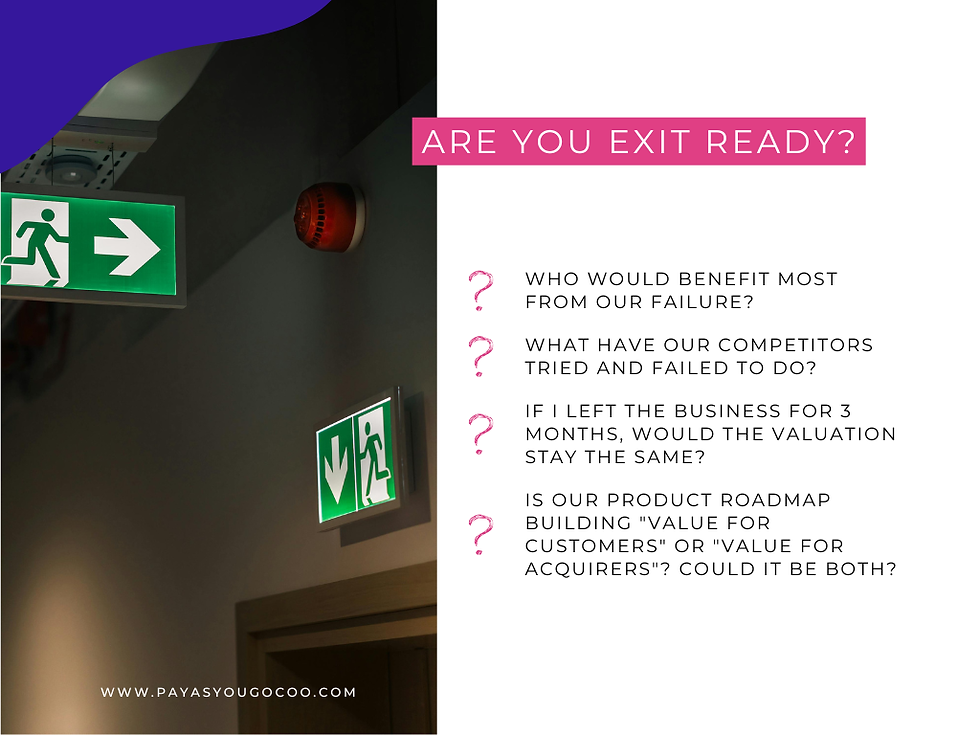
Who are the top 5 companies that would benefit most from our failure?
(Your best acquirers are often those you currently annoy the most. Buying you to take you off the market is not an uncommon strategy).
What is the one thing we do that our biggest competitor has tried and failed to do?
If I left the business for 3 months, would the valuation stay the same?
Is our product roadmap building "Value for Customers" or "Value for Acquirers"? Could it be both?
If you're reading this and thinking you could do with some support to navigate the practicalities of this inside your own org, give us a shout - we've got hella experience.


Comments