.png)
How To: Write A Go-To-Market Strategy For Your Startup


I'm a big "series" fan. I love nothing more than a show with 500 episodes I can lose myself in. I'm sure it probably says something about my general anxieties and need for comfort and the familiar (let's not interrogate too much the fact that, whilst I can watch 500 episodes of one show back to back, I can't focus on a single, decently-sized movie...); whatever it is that's driving it, I like 'em.
I also like making series for you (I'm so generous). I've made ones on Investment Readiness, different Strategy frameworks, and what a COO actually does all day.
And now we have a new one, this one. A series on short "How To Guides" that was in no way created because my keyword research told me to make some short "How To Guides" and was in many ways created because it's super useful advice that you should absolutely read.
Let's dig into the first one - how to write a Go-To-Market strategy for your startup.
What is a Go-To-Market strategy for a startup?
There is a common, and often expensive and time-consuming, misconception in the startup world that "Go-To-Market" is just a fancy term for "Marketing."
They're linked, but they're not the same - some Go-To-Market work is "marketing", but there's a lot more to the puzzle than that one piece.
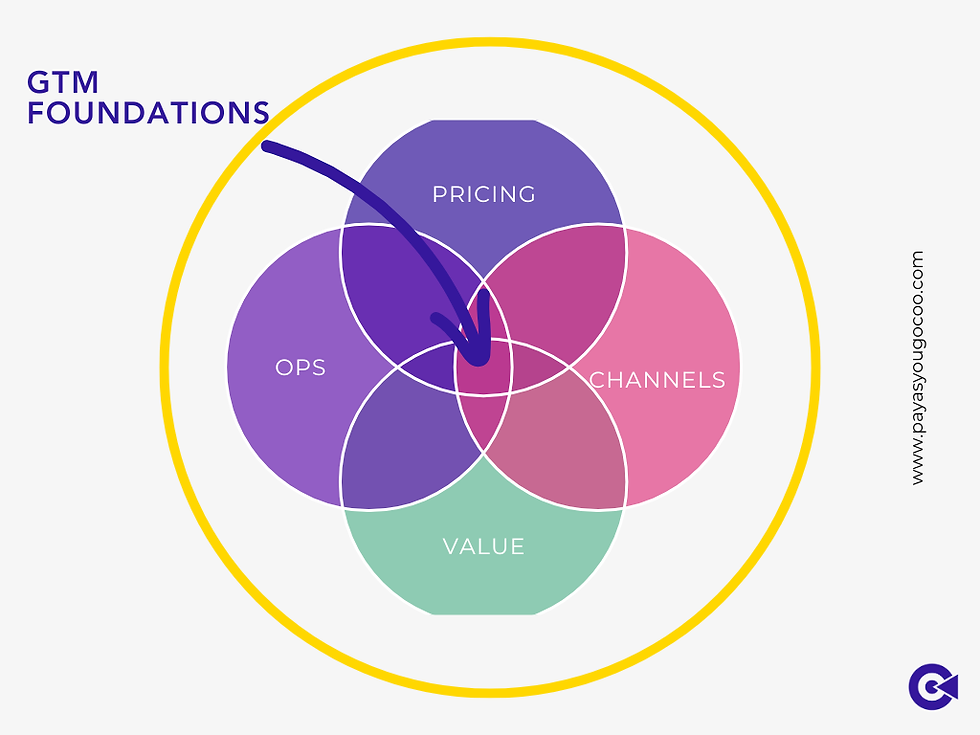
At its core, a Go-To-Market (GTM) strategy is a comprehensive plan that details how a company will launch a new product to a specific audience, how that product will reach a certain level of competitive advantage, and (most importantly) build a repeatable sales engine.
While a marketing plan focuses on how and where you talk to the market, a GTM strategy answers the broader, more structural questions:
Pricing & Packaging: How much are you charging, and does that price point actually support your cost of (customer) acquisition?
Sales Channels: Are you selling via a self-service website, or do you need, for example, a high-touch enterprise sales team? Is it both?
Operational Readiness: Can your current team and tech stack handle the fulfilment, onboarding, and support of the customers your marketing team is about to find?
The Value Loop: How does the product/service/productised service itself lead to more growth?
If your marketing plan is the "invitation" to the party, your GTM strategy is the logistics that ensure the house doesn't burn down, the drinks don't run out, and the guests actually want to stay. Look at me talking like I go to parties.
For an early-stage business, messing up the distinction between the two is a pretty quick way to burn through your runway with nothing but "awareness" to show for it.
The four pillars of a Go-To-Market strategy for a startup
There are four core elements to a good Go-to-Market Strategy for a startup and they all need to be in alignment. If one is out of sync (for example, if your "How" is too expensive for your "Price") the whole thing will fall apart. Let's break them down:
1. The "Who" (your "Ideal Customer Profile" or "ICP")
In the early days, "everyone" is a tempting target to set for the market you want to acquire.

But for a GTM strategy, "everyone" is a death sentence.
I break this down in a lot of detail (with handy summaries at the end of each chapter) in one of my books - How To Find Your Customers, but, in summary, you need to be more "targeted" with your "Target market".
You need to move beyond "everyone", and beyond vague demographics (e.g., "SMEs in the UK") and focus on specific pain points and trigger events.
Don’t just target a Marketing Manager; target a Marketing Manager at a Series A startup who has just inherited a messy CRM and has a board meeting in three weeks. That is a person who is ready to buy.
2. The "What" (your Value Proposition)
Your Value Prop is, quite simply, the value that you're suggesting that you'll deliver to your customers via your product or service.
It isn't a list of features; it’s the answer to two crucial questions: "Why you?" and "Why now?". Through those two questions, you quickly and easily communicate to your customers why they need to buy your product or service, sooner rather than later.
Why you: What's your advantage? What makes your solution better than the status quo?
Why now: What's the external pressure (regulation, economic shift, internal crisis) that makes solving this problem an urgent priority for your customers rather than a "nice-to-have" for next quarter?
3. The "How" (your distribution & sales)
This is where the operational rubber meets the strategic road. Here, you need to figure out how you're going to get to these ideal customers and deliver them the message that your solution is what they need now.
Direct Sales: a high-touch, high-cost, but high-control approach. This requires people.
Channel Partners: e.g. leveraging someone else's audience. This one has the potential to be efficient, but you lose a margin and some control as the flip-side of not hiring your own direct sales team.
Product-Led Growth (PLG): The product sells itself through a "freemium" or self-service model. Your choice here dictates your entire hiring plan and tech stack. Very likely not suitable for a service - although some productised services, like our Business Coaching packages, are suitable for a PLG approach.
4. The "Price" (Financial Strategy)
Finally, you need to figure out what you're charging for your product or service. And you also need to figure out why you're charing that because pricing isn't a mere number, it’s a strategic lever that needs to be linked directly to your unit economics as much as to the size of your customers' wallets.
As a simple example, if your Customer Acquisition Cost (CAC) is £1,000, you can't survive with a £10/month price point, even if that's all the customer can pay. You'd be losing £880 per customer over a year at a minimum, without even considering your operational costs.
Your GTM strategy needs to be designed in such a way that your Lifetime Value (LTV) is significantly higher than the cost of winning that customer. If the maths isn't mathsing on paper, it definitely won’t work in the market (and it won't be impressing any investors).
The role of operational readiness in Go-To-Market strategies for startups
In a shocking turn of events for this website, I, a COO obsessed with Strategy and operations, am going to tell you why your operational plan is key to a successful GTM motion.
If you're reading this an a fellow operator, I'm sure there's an element of "Well, yes, obviously" to your response to this section, but this is where a lot of GTM plans fall apart.
You can have the slickest marketing in the world and a sales team of cold-calling assassins, but if your internal operations aren't ready, you're pretty much just speeding up your own demise.
In my experience as a battle-worn COO, I can confidently roll my eyes and tell you that a Go-to-Market Strategy might seem like it's the purview of the front-facing teams, but in reality it's actually a promise that they're making with someone else's cheque book - specifically, that of the back of house or operations team.
Operational Readiness
Before you flip the switch on your GTM execution, you HAVE TO audit your Operational Readiness. Absolutely key to the success of a GTM is your ability to actually deliver it. Some key areas to consider:
Onboarding bottlenecks: Do you have a documented, repeatable process for getting a new customer from "Closed Won" to "Active User"? If this relies on a founder manually sending an email, you aren't ready to go to market...
Feedback loops: How does information travel from the sales team (who hear the objections) to the product team (who build the fixes)? Without a formalised process, you’re flying blind. NOTHING EXISTS IN A SILO. Genuinely getting that tattooed on my arm one day. Right next to the one that says "Don't let the bastards grind you down."
Support burden: More customers mean more questions, more bugs, and more edge cases. If your "Support Team" is just an overworked engineer (or, more often, an overworked founder with a fake email address that's pretending to be an overworked engineer - I swear to anyone who received an email from "Colin" at Pay As You Go COO that I'm not speaking from experience...), your GTM will lead directly to churn. Expensive churn.
In the very early stages, it’s fine to do things that don't scale - like hand-holding every customer. But your GTM strategy MUST include a plan for when that stops being possible.

Operational readiness means building fixes for the productivity debt into your roadmap. It’s about ensuring your CRM, your billing systems, and your customer success workflows are robust enough that they don't become the ceiling for your growth. If you can't fulfil the demand you're creating, you aren't growing, you're just failing more publicly.
Is it good yet?
To measure whether your Go-To-Market strategy is working for your startup, you need to start defining some key metrics - specifically your underlying unit economics.
The gold standard for GTM success lies in the relationship between your Customer Acquisition Cost (CAC) and Lifetime Value (LTV). Some would say that you need to be looking for an LTV that is at least three times your CAC, but let's just start with an LTV that's higher than your CAC and build from there.
Next, look at how long it's taking you to get that LTV. Revenue isn't cash flow and the CAC Payback Period (the number of months it takes to recoup the cost of winning a customer) needs to be taken into consideration if you don't want to run out of money. If your payback period is longer than your cash runway, your GTM strategy is essentially a countdown to insolvency. Please, please get a dashboard - I have a great Google Sheets template if you need. Tracking these metrics in real-time allows you to pivot from a "gut-feel" launch to a data-driven sales engine that investors can actually get behind.
Ultimately, a GTM strategy is a living breathing system (just like your wider Strategy), not a static document you file away after the first board meeting. It requires constant calibration between your strategic vision and your operational reality to ensure that as you scale, you aren't just getting bigger, but getting better.
If you're struggling with yours and want some help, give us a shout via the link below (it's freeee).


Comments